|
|||
|
What’s the most famous, most popular visitor attraction in Central Florida? Throughout the 1950s and 1960s, the answer would have been Cypress Gardens. On October 15, 2011, the former Cypress Gardens park reopened as LEGOLAND Florida—a park that’s simultaneously brand new and more than 75 years old. I had the pleasure of visiting LEGOLAND Florida on its Grand Opening day and on a preview one day earlier. In a series of articles, I’ll look at the park’s past, present, and future.
|
|||
 |
|||
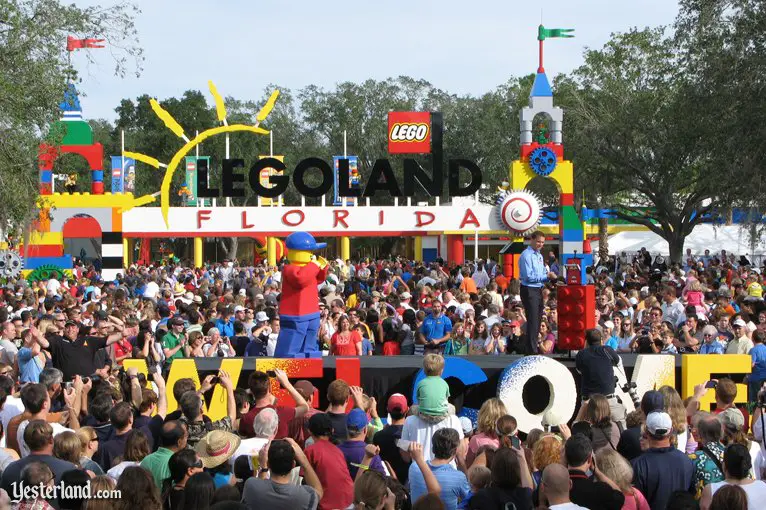
Grand Opening Ceremony at the entrance to LEGOLAND Florida (October 15, 2011) |
|||
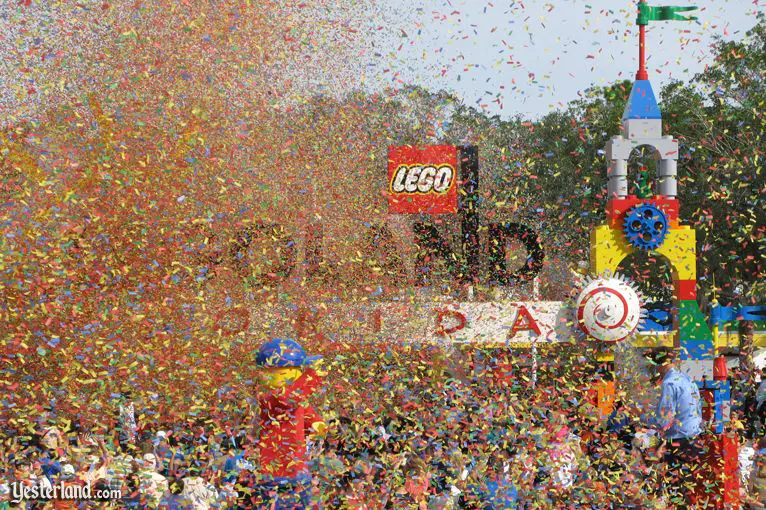
Confetti in LEGO colors at the end of the Grand Opening ceremony (October 15, 2011) |
|||
|
Merlin Entertainments Group opened their first attraction in Florida on October 15, 2011—LEGOLAND Florida, “a 150-acre interactive theme park dedicated to families with children between the ages of 2 and 12.” But this website is Yesterland, so our story begins much earlier. Here’s an old Cypress Gardens press release from 2001, along with photos from 1983 and 2011: |
|||
|
A BRIEF HISTORY OF CYPRESS GARDENS CYPRESS GARDENS, Fla.—They say Cypress Gardens founder Dick Pope, Sr. was born in the midst of an Iowa cyclone. And, the energy of that cyclone—and the bluster—was absorbed by Pope and drove him energetically through all his life. Born at the dawn of the new century, Pope came to Florida with his father at age 11 and honed his sales skills helping his dad sell real estate, closing his first deal at the age of 12. He met and married his life partner, Julie Downing, in 1926. After the Florida real estate market went bust in 1927, Pope needed a way to support his new wife. Outboard motors were just coming into use and Dick had heard that one manufacturer was planning a publicity campaign. He shoved his bride into a car and started driving to the company’s (Johnson Outboards) headquarters. At every city en route, Dick stopped and sent a telegram to the president: “Hold all publicity plans until I get there. Your problem is solved.” The company, bowled over by his high-pressure approach, gave him a $1,000 a month job. He staged death-defying boat races all over the state of Florida to publicize the introduction of the famous Johnson SeaHorse outboard motor. He became so successful that he started his own public relations agency. His client list grew and he had elegant offices in the prestigious Tribune building in Chicago and the Graybar building in New York. But Pope had been touting the Sunshine State for so long he had convinced himself that Florida was the only place to live. So, in the midst of the worst depression this country has ever suffered through, he and Julie decided to head back to the land of oranges. According to Pope, “This all came about, you know, because Julie showed me an article in Good Housekeeping, while we were living in New York, about a banker in Charleston who had opened his private estate to the public, and charged admission and had taken in $36,000 cash in one year—a big sum in those days. It stayed in our minds, and one day after we decided to come back to Florida, we talked it over and said, ‘someday we’d build a Garden, so I could be president—and attract visitors to Winter Haven!’“ In the latter part of 1932—while Florida was in the grip of the depression that followed the boom—he sold the WFERA—a branch of the WPA—on the idea that instead of having men raking leaves at a dollar a day, they could beautify and rebuild the canals and chain of lakes. They started on that, and then planned on adding a hanging garden on Lake Eloise—and that’s what later became Cypress Gardens. At that time, he was chairman of the canal commission for the Lake Region, so that the property was put in their name. But after spending about $3,500 of government money and $1500 of the canal commission’s money, opposition to the project locally became so severe that it was canceled by the WFERA and the canal commission was repaid its $1,500 and deeded the property over to the Florida Cypress Gardens Association, Inc. |
|||
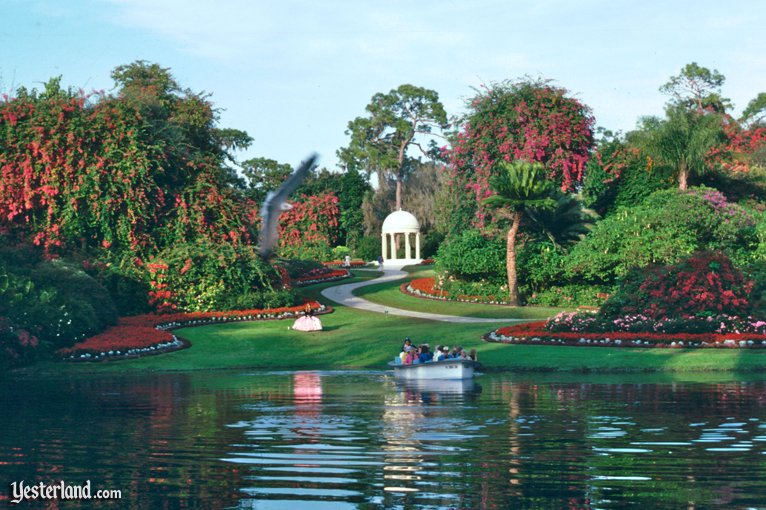
The original botanical gardens at Cypress Gardens (1983 photo) |
|||
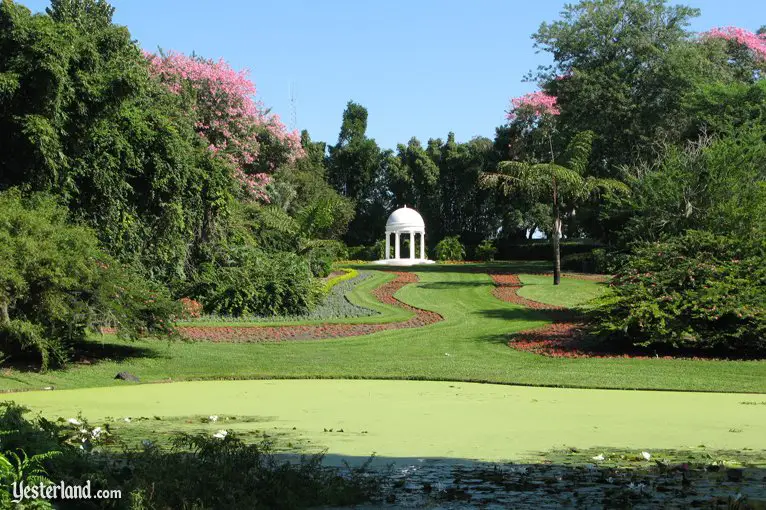
The original botanical gardens in the Cypress Gardens section of LEGOLAND Florida (2011 photo) |
|||
|
Working side by side with the laborers in the muck, Pope began constructing his dream garden. Many in the press laughed at the idea of building a beautiful tropical showcase in the middle of a 16-acre marsh, calling him “Maharaja of Muck” and “Swami of the Swamp.” But, he persevered. Dick didn’t know one flower from another, but Julie Pope, born and raised in Brewton, Ala., knew plants, loved them and had a “green thumb.” Always a picture enthusiast, Pope set up an 8 by 10 view camera while laying out paths to be sure he could get good picture compositions with his plantings. If a big tree or lagoon appeared as an obstacle, he went around it with his walkways (and besides, it cost money to build bridges and fill stump-holes). Finally, on January 2, 1936, the gates opened on what would become a showplace for 8,000 varieties of flowers from over 90 different countries. In 1938, the first electric boats began gliding through the tropical canals. |
|||
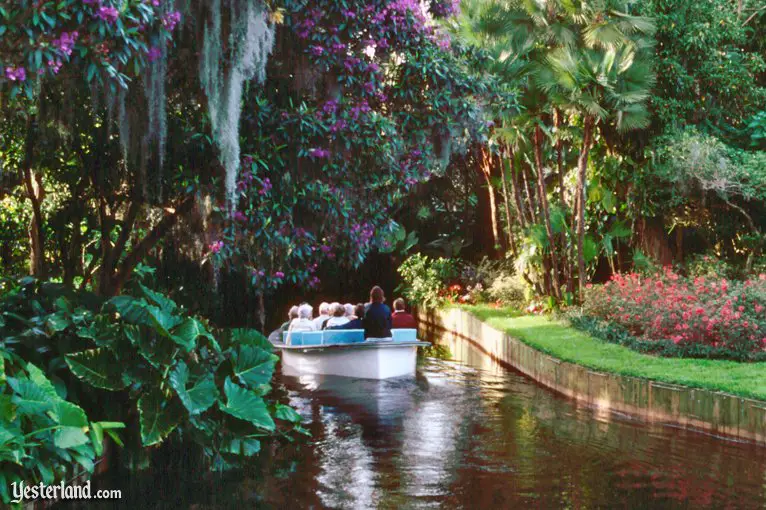
Electic boat ride through the manicured canals of the botanical garden (1983 photo) |
|||
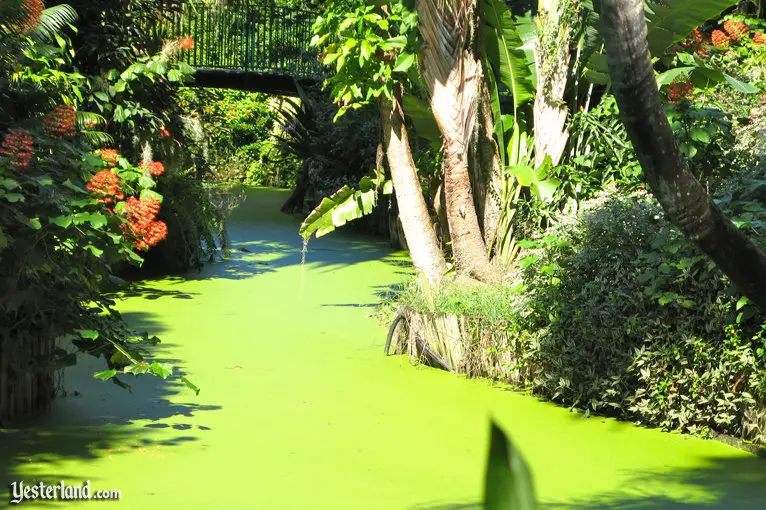
Unused canal at LEGOLAND Florida (2011 photo) |
|||
|
Pope’s newsreels, photographs, and tireless showmanship soon resulted in countless images of beautiful women, palm trees, exotic flowers and always-sunny Florida skies published around the world. He was proclaimed “Mr. Florida,” first citizen of the state and, in time, the “Father of Florida Tourism.” Through the years, some of Cypress Gardens’ icons came about out of necessity. For instance, in 1940, the vine on the cypress wall, the first thing a visitor sees when he arrives, became frozen and died—all the plants in the park were protected by smudge pots. Besides, it was cold out, discouraging to a visitor. Twenty people drove up the first day and drove away again without going in. |
|||
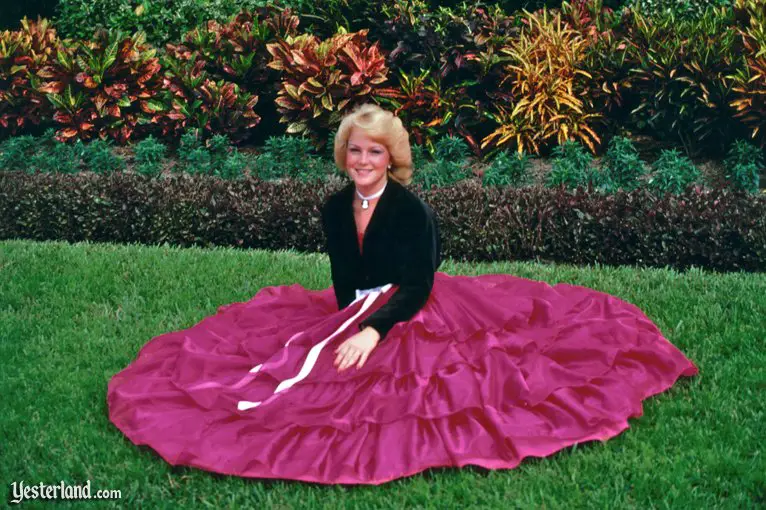
A Southern Belle at Cypress Gardens (1983 photo) |
|||
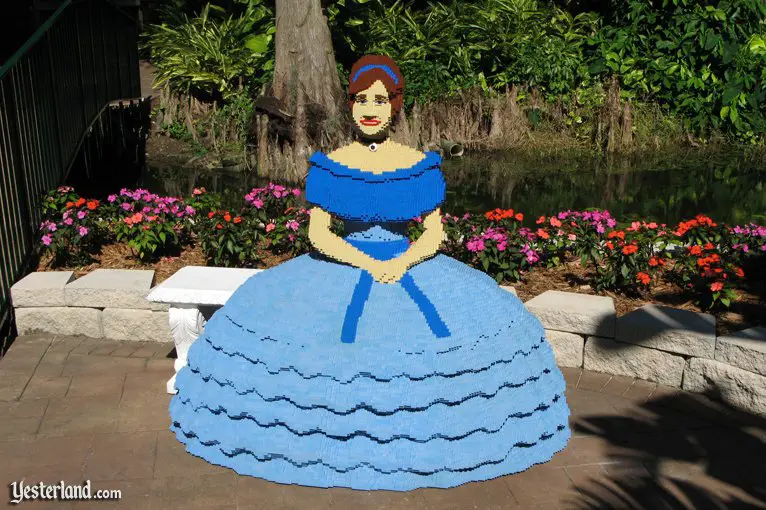
A Southern Belle in the Cypress Gardens section of LEGOLAND Florida (2011 photo) |
|||
|
Mrs. Pope called one of the girls. “Put on an old-fashioned dress,” she said. “That will be warm without looking warm and we’ll put a shawl on your shoulders. Then you go stand by that dead vine and flirt with everybody that comes in so hard that they don’t see the vine.” People quit going away without entering the gardens. In fact, they quit seeing the dead vine. The gracious Southern Belles became a tradition that is an ongoing part of the beauty of the Gardens. |
|||
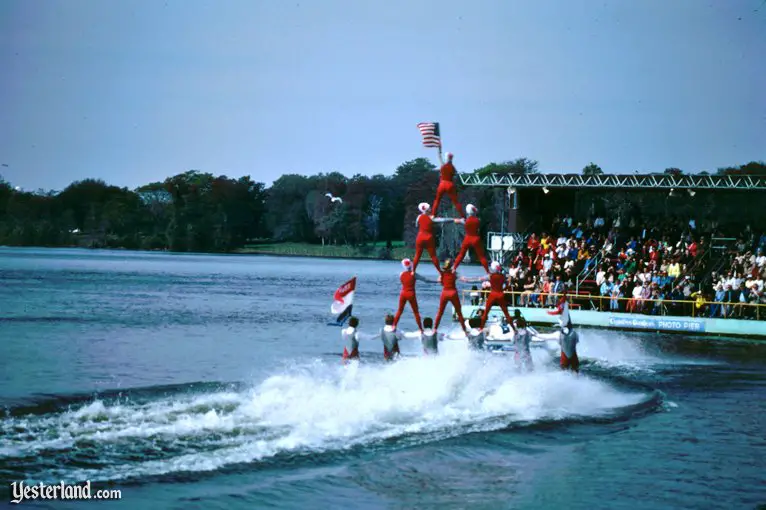
The famous Cypress Gardens human pyramid (1983 photo) |
|||
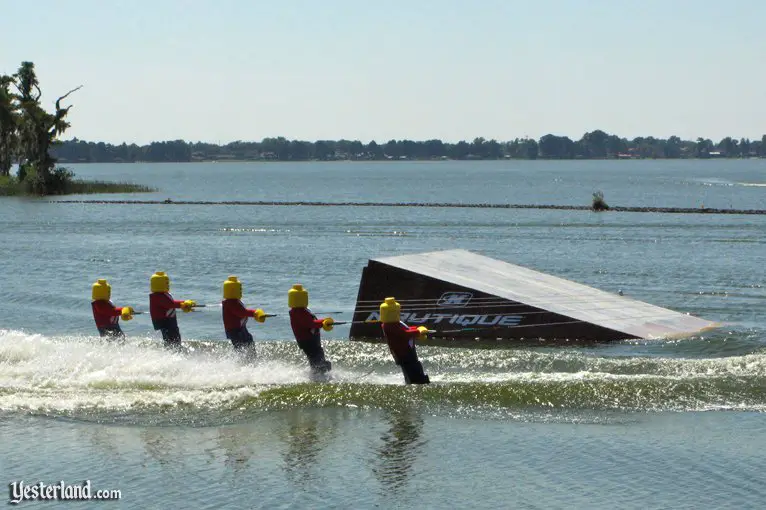
Waterskiing LEGO soldiers at LEGOLAND Florida (2011 photo) |
|||
|
The world famous water ski show had the same sort of beginning. In 1943, while Pope was serving in World War II, one of the photos in a local newspaper featured water skiers being pulled by a boat at Cypress Gardens. Several soldiers in the area came to see the “water show,” even though none existed. But Julie, the consummate businesswoman, rounded up her children and their friends to stage the park’s first water ski show. The next weekend, 800 soldiers showed up, and the rest, as they say, is history. Cypress Gardens was soon dubbed the “water ski capital of the world,” a distinction it still enjoys today. |
|||
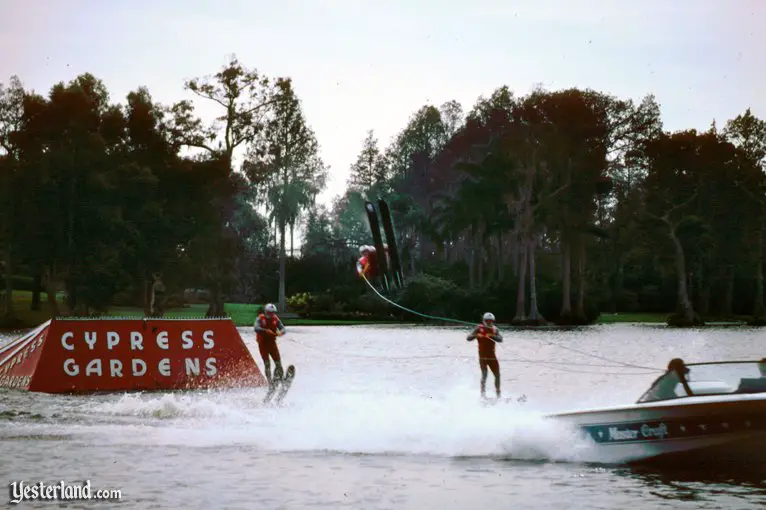
Amazing water ski ramp jumps at Cypress Gardens (1983 photo) |
|||
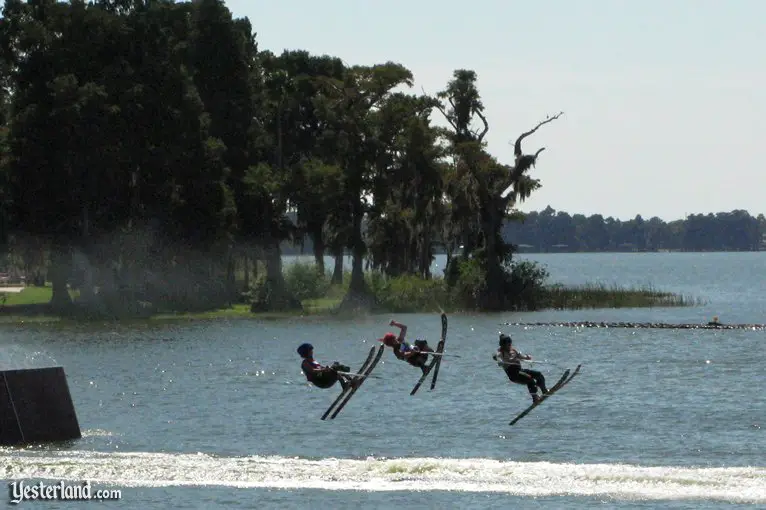
Amazing water ski ramp jumps at LEGOLAND Florida (2011 photo) |
|||
|
Celebrities and Hollywood movie producers discovered Cypress Gardens in the late ‘40s, ’50s and ’60s, including Elvis Presley, Esther Williams and Johnny Carson. Full length features including “On an Island With You,” “Easy to Love,” parts of “Moon Over Miami,” “This is Cinerama,” and hundreds of short features flooded movie theaters all over the country, building the tremendous recognition of the gardens. Cypress Gardens expanded during the ’70s and ’80s to compete with new Central Florida theme parks springing up. In the early ’80s, Pope retired and passed the reins to his son, Dick Jr. |
|||
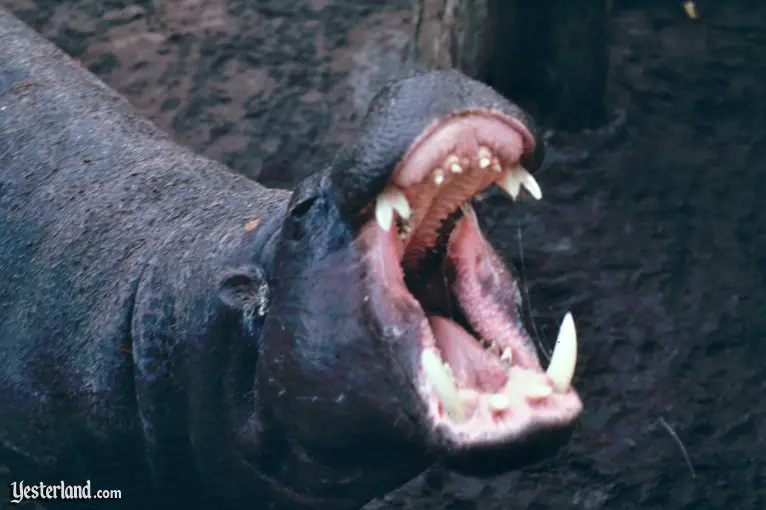
A hippo in the zoo section added to Cypress Gardens in the early 1980s (1983 photo) |
|||
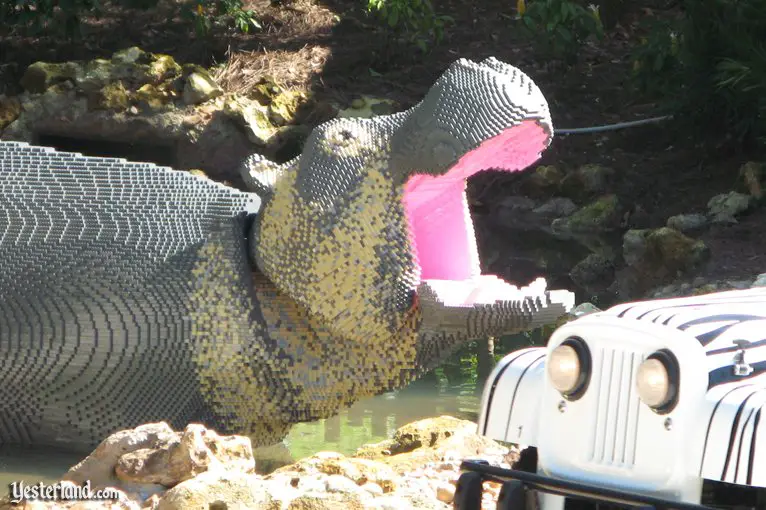
A LEGO hippo on the Safari Trek ride at LEGOLAND Florida (2011 photo) |
|||
|
In June 1985, after almost a half-century of Pope family ownership and involvement, Cypress Gardens was sold to publishing conglomerate Harcourt Brace Jovanovich. HBJ sunk several million dollars into a new package of attractions, shows and food concessions before selling Cypress Gardens and four Sea World parks to Busch Entertainment Corporation (BEC) in 1989. During BEC’s tenure, the park again underwent capital expansions and improvements, including the introduction of more new attractions, shows, shops and festivals. In 1995, BEC sold Cypress Gardens to the park’s own management team. Back in the hands of local owners, Cypress Gardens attendance has since flourished with such new attractions as a spring light show, ice skating show, variety show and zoo. And, in 1999, the park added an authentic paddle wheel boat for sightseeing tours and romantic brunch and dinner cruises. “Not only do we have Dick Pope’s legacy to live up to, but we purchased a Florida tourism icon that is as well branded as Proctor and Gamble,” said Bill Reynolds, president and CEO. “As stewards for this incredible historic attraction, we are strategically planning the future of the park to ensure its position as one of Florida’s true tourism treasures. We will continue to emphasize the park’s traditional heritage as a world-famous botanical garden and water ski capital as well as introduce new entertainment elements designed to appeal to all ages.” |
|||
|
The press release concluded with Cypress Gardens’ location, hours, and prices. Although the press release claimed that Cypress Gardens attendance flourished after the park’s management assumed ownership, the real story wasn’t that rosy. The owners made a valiant effort to attract guests with new shows, seasonal events, and attention to the qualities and traditions that made the park famous in the first place. |
|||
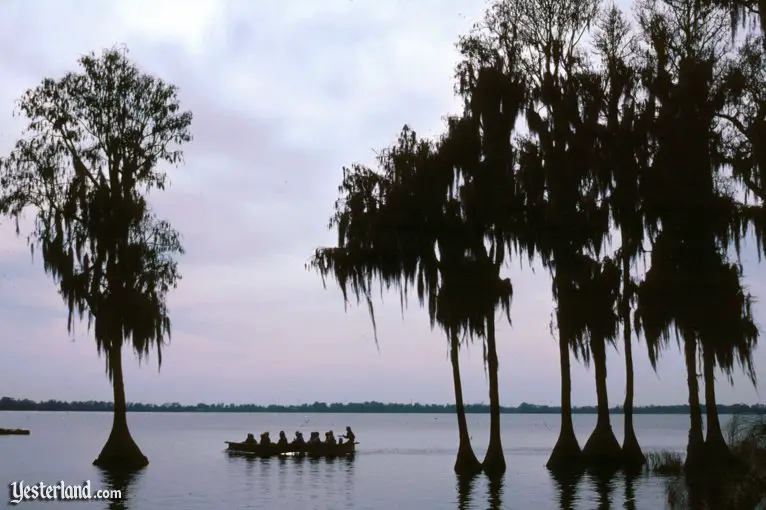
Boat of Lake Eloise (1983 photo) |
|||
|
There were no roller coasters or other stomach churning hardware typically found at theme parks. The Electric Boats provided a lovely way to see the botanical gardens. A different boat went out into Lake Eloise, on whose shore the park sat. An unusual attraction called the Island in the Sky lifted dozens of guests at a time with a giant crane arm for a panoramic view of the park from above. There were some children’s rides too. The emphasis was on shows and exhibits. Wings of Wonder was a walk-in butterfly conservatory. Cypress Junction was an unbelievably elaborate model train exhibit. There were seasonal floral exhibits that provided guests with new things to see all year long. Patagonian cavies, capybaras, and other critters were on display in the Nature’s Boardwalk zoo area. At every turn there was something to see. |
|||
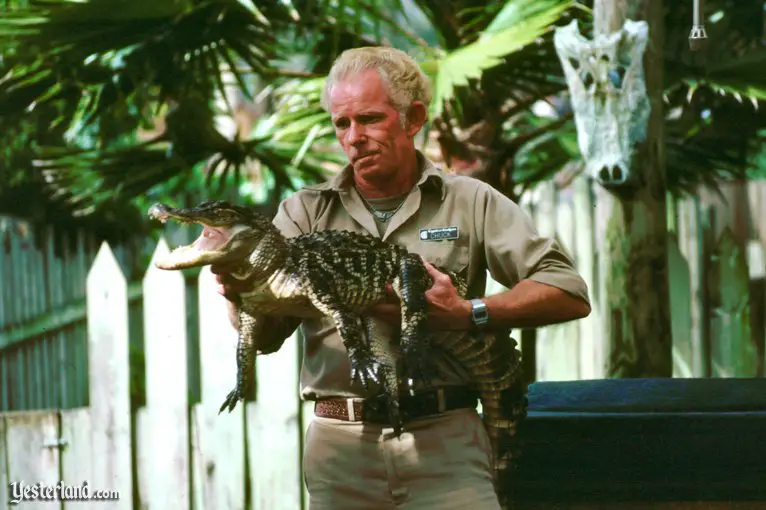
The Gator Show at Cypress Gardens (1983 photo) |
|||
|
Back in the 1980s, the park had a Gator Show, a Duck Show (in which ducks played musical instruments), and a Bird Show. By the late 1990s, performing animals gave way to an ice skating revue and a small circus with a genuinely clever and engaging clown. Despite all the efforts, not enough visitors made the 45-minute drive from the Walt Disney World area to the historic park that had once been the region’s top attraction. |
|||
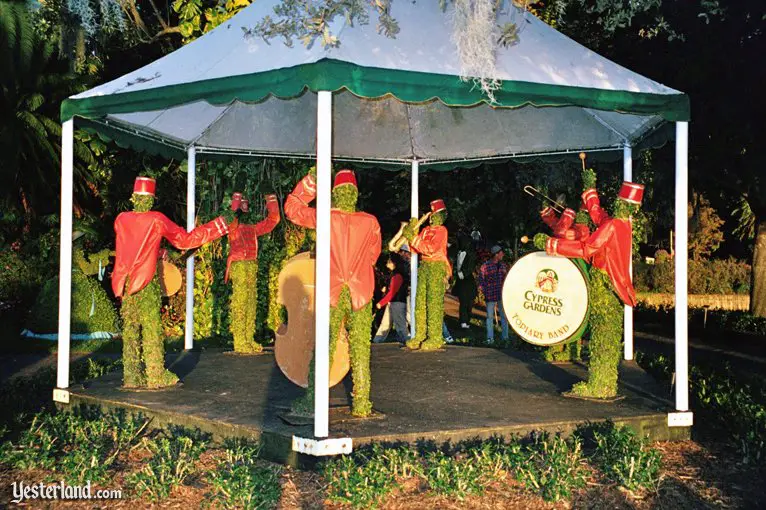
We’re Cypress Gardens’ Topiary Band |
|||
|
After years of declining attendance, the owners of Cypress Gardens announced that the park would welcome guests for the last time on Sunday, April 13, 2003. What would happen to Cypress Gardens now? Within days of the park’s closing, there were newspaper reports that the State of Florida was studying the possibility of purchasing Cypress Gardens. The Associated Press (AP) quoted Bob Ballard, Florida’s deputy secretary of the Department of Environmental Protection, saying, “What a grand park this is. It’s truly not only a Florida landmark but a national landmark, an international landmark.” It remained to be seen how much of the 200-acre property would have a future that didn’t include condominiums or home sites. At the very least, the original 37-acre core of the park, including the botanical gardens, deserved to be saved for future generations. Maybe the core gardens would be saved as a public park by the state of Florida, but it seemed likely that the rest of the real estate would give way to a more profitable use. Then there seemed to be a happy ending. Kent Buescher, owner of the successful Wild Adventures theme park in Valdosta, Georgia, acquired Cypress Gardens. His plan was to broaden the appeal of Cypress Gardens by spending $50 million for standard family amusement park rides. On December 9, 2004, Cypress Gardens reopened as Cypress Gardens Adventure Park. In addition to the famed botanical gardens and water ski show, the reopened park offered four roller coasters and dozens of other rides. It was good to see Cypress Gardens resuscitated, even if the medicine involved “off the shelf” rides. The park struggled through the 2004 hurricanes, bankruptcy in 2006, another ownership change in 2007, and a temporary closure in 2008 to deemphasize rides in favor of water park attractions. Cypress Gardens failed to find a formula that generated enough turnstile clicks while keeping operating costs under control. In the end, the park didn’t have what it takes to survive among the great theme parks of Central Florida. The park shut down again in September 2009. This time, there was a rumor that the owners of LEGOLAND might be interested in the site. The rumor was confirmed as true in January 2010. We’re now back to where this article began. LEGOLAND Florida opened on October 15, 2011. There is far more to the new park than just the historic gardens and the new pirate-themed water ski show. The park has themed lands, including Land of Adventure, LEGO Kingdoms, and Miniland. One of the lands of LEGOLAND Florida has a familiar name. It’s called Cypress Gardens, encompassing most of the historic botanical garden (with plans to restore and include more). |
|||
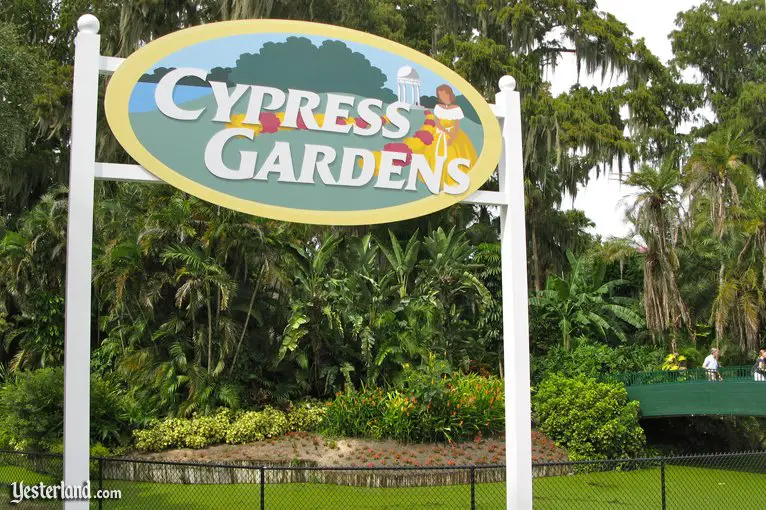
New Cypress Gardens sign at LEGOLAND Florida (2011 photo) |
|||
|
The new land even has a new sign. The sign wasn’t there on October 14, the media preview day. But on October 15, the Grand Opening day, the new sign welcomed guests to a very old part of the park—one that should gradually return to its former glory. |
|||
|
|
© 2011 Werner Weiss — Disclaimers, Copyright, and Trademarks Updated October 21, 2011.
All photos by Werner Weiss; year of photo as indicated in caption. |
||

 , Curator of Yesterland, October 21, 2011


